Science Savvy
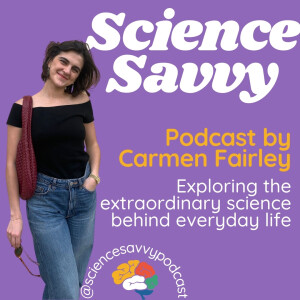
Welcome to Science Savvy, where I, Carmen Fairley, leverage my background in Pharmacology and Biomedical Engineering to explore the extraordinary science behind everyday life. I want you to fall in love with science like I did, and realise it doesn't have to be inaccessible jargon. We cover topics from interviews with researchers at the forefront of healthcare, through to mental health, and even topics around love, friendship, and family, to help YOU see that cool science is EVERYWHERE. New episodes every two Fridays. Follow now and never miss an episode!
Listen on:








Episodes
Tuesday Dec 10, 2024
Tuesday Dec 10, 2024
Welcome to the Creativity episode, part of Science Savvy with Carmen. In this episode, I explore the science behind creative thinking and how the brain fuels imagination. With my background in pharmacology and biomedical engineering, I break down the science behind creativity and unpack how it shows up in your daily life.
This episode covers the roles of the prefrontal cortex and default mode network, the surprising impact of dopamine on creative flow, and how certain brain states enhance idea generation. Joined by my friend Alicia, an artist and entrepreneur with a background in psychology, we look at how both science and lived experience shape creative expression. Whether you’re an artist, a science enthusiast, or just curious about where great ideas come from, this episode offers clear and engaging insights grounded in real research.
Science Savvy helps you understand the systems shaping your thoughts, health, and behavior. If you're ready to explore your body and brain with a little more clarity, you're in the right place.
Further reading and references:
Adnan, A., Beaty, R., Silvia, P., Spreng, R. N., & Turner, G. R. (2019). Creative aging: Functional brain networks associated with divergent thinking in older and younger adults. Neurobiology of Aging, 75, 150–158. https://doi.org/10.1016/j.neurobiolaging.2018.11.004Kulisevsky, J., Pagonabarraga, J., & Martinez-Corral, M. (2009). Changes in artistic style and behaviour in Parkinson's disease: Dopamine and creativity. Journal of Neurology, 256(5), 816–819. https://doi.org/10.1007/s00415-009-5001-1Weinberger, A. B., Green, A. E., & Chrysikou, E. G. (2017). Using transcranial direct current stimulation to enhance creative cognition: Interactions between task, polarity, and stimulation site. Frontiers in Human Neuroscience, 11, 246. https://doi.org/10.3389/fnhum.2017.00246Chi, R. P., & Snyder, A. W. (2012). Brain stimulation enables the solution of an inherently difficult problem. Neuroscience Letters, 515(2), 121–124. https://doi.org/10.1016/j.neulet.2012.03.012
Tuesday Nov 26, 2024
Tuesday Nov 26, 2024
Welcome to the Gut Health episode, part of Science Savvy with Carmen. In this episode, I explore how your gut microbiome does so much more than support digestion. With my background in pharmacology and biomedical engineering, I break down the science behind the gut-brain connection and unpack how it shows up in your daily life.
This episode covers how gut bacteria influence your mood, mental health, immune function, and even decision-making. I share fascinating research on the relationship between the microbiome and depression, explain the biological pathways linking your gut to your brain, and offer practical tips for improving gut health through diet and lifestyle. Whether you're curious about probiotics, interested in the science of mood, or simply want to understand your body better, this episode offers clear and engaging insights grounded in real research.
Science Savvy helps you understand the systems shaping your thoughts, health, and behavior. If you're ready to explore your body and brain with a little more clarity, you're in the right place.
Further reading and references:
Bercik, P., & Collins, S. M. (2014). The effects of the microbiota on the central nervous system and behavioral disorders. Gastroenterology, 146(6), 1449-1458. https://doi.org/10.1053/j.gastro.2014.02.037Cryan, J. F., & Dinan, T. G. (2012). Mind-altering microorganisms: The impact of the gut microbiota on brain and behaviour. Nature Reviews Neuroscience, 13(10), 701-712. https://doi.org/10.1038/nrn3346Foster, J. A., Rinaman, L., & Cryan, J. F. (2017). Stress and the gut-brain axis: Regulation by the microbiome. Neurobiology of Stress, 7, 124-136. https://doi.org/10.1016/j.ynstr.2017.03.001Mayer, E. A., Padua, D., & Tillisch, K. (2014). Altered brain-gut axis in autism: Comorbidity or causative mechanisms. BioEssays, 36(10), 933-939. https://doi.org/10.1002/bies.201400075Clarke, G., Stilling, R. M., Kennedy, P. J., Stanton, C., Cryan, J. F., & Dinan, T. G. (2014). Minireview: Gut microbiota: The neglected endocrine organ. Molecular Endocrinology, 28(8), 1221-1238. https://doi.org/10.1210/me.2014-1108Sampson, T. R., & Mazmanian, S. K. (2015). Control of brain development, function, and behavior by the microbiome. Cell Host & Microbe, 17(5), 565-576. https://doi.org/10.1016/j.chom.2015.04.011O'Mahony, S. M., Clarke, G., Dinan, T. G., & Cryan, J. F. (2015). Early-life adversity and brain development: Is the microbiome a missing piece of the puzzle. Neuroscience, 342, 37-54. https://doi.org/10.1016/j.neuroscience.2015.09.068Ridaura, V. K., et al. (2013). Gut microbiota from twins discordant for obesity modulate metabolism in mice. Science, 341(6150), 1241214. https://doi.org/10.1126/science.1241214Dash, S., Clarke, G., Berk, M., & Jacka, F. N. (2015). The gut microbiome and diet in psychiatry: Focus on depression. Current Opinion in Psychiatry, 28(1), 1-6. https://doi.org/10.1097/YCO.0000000000000117Madra, M., & Ringel, Y. (2015). The role of probiotics in treating irritable bowel syndrome. Gastroenterology Clinics of North America, 44(1), 159-175. https://doi.org/10.1016/j.gtc.2014.11.013Jacka, F. N., et al. (2017). A randomized controlled trial of dietary improvement for adults with major depression (the SMILES trial). BMC Medicine, 15, 23. https://doi.org/10.1186/s12916-017-0791-yStaudacher, H. M., et al. (2017). Probiotic and prebiotic mechanisms to improve mental health via the gut-brain axis. Current Opinion in Pharmacology, 38, 69-77. https://doi.org/10.1016/j.coph.2018.03.008Kong, X., et al. (2020). Probiotics supplementation during antibiotic treatment reduces the risk of Clostridium difficile-associated diarrhea. The American Journal of Gastroenterology, 115(6), 921-929. https://doi.org/10.14309/ajg.0000000000000601Mills, J. P., et al. (2017). The impact of cesarean delivery on the diversity of the infant gut microbiome. Microbial Ecology in Health & Disease, 28(1), 13777. https://doi.org/10.1080/16512235.2017.13777
Tuesday Nov 12, 2024
Tuesday Nov 12, 2024
Welcome to the Consciousness episode, part of Science Savvy with Carmen. In this episode, I explore what it really means to be conscious and how self-awareness shapes who we are. With my background in pharmacology and biomedical engineering, I break down the science behind consciousness and unpack how it shows up in your daily life.
This episode covers everything from classic philosophical ideas like Descartes’ “I think, therefore I am” to modern neuroscience frameworks such as Crick’s Astonishing Hypothesis and Tononi’s information integration theory. We explore how brain chemistry, genetics, and personal experience come together to influence identity, self-esteem, and the feeling of being a self at all. Whether you’re curious about how the brain creates your sense of self or interested in the science behind awareness and emotion, this episode offers clear and engaging insights grounded in real research.
Science Savvy helps you understand the systems shaping your thoughts, health, and behavior. If you're ready to explore your body and brain with a little more clarity, you're in the right place.
Further reading and references:
Crick, F. (1994). The Astonishing Hypothesis: The Scientific Search for the Soul. Scribner.Chalmers, D. J. (1995). Facing up to the problem of consciousness. Journal of Consciousness Studies, 2(3), 200-219.Tononi, G. (2004). An information integration theory of consciousness. BMC Neuroscience, 5(42).Koch, C., Massimini, M., Boly, M., & Tononi, G. (2016). Neural correlates of consciousness: progress and problems. Nature Reviews Neuroscience, 17(5), 307-321.Northoff, G., Heinzel, A., de Greck, M., Bermpohl, F., Dobrowolny, H., & Panksepp, J. (2006). Self-referential processing in our brain. NeuroImage, 31(1), 440-457.Lieberman, M. D., & Eisenberger, N. I. (2009). Pains and pleasures of social life. Science, 323(5916), 890-891.Panksepp, J. (1998). Affective Neuroscience: The Foundations of Human and Animal Emotions. Oxford University Press.
Tuesday Oct 15, 2024
Tuesday Oct 15, 2024
In this episode of Science Savvy, we tackle one of the most common yet least understood experiences in women’s health: why do we get periods. From evolutionary theories to hormonal rollercoasters, I explore the biology and history behind menstruation and the science that underlies symptoms like bloating, mood swings, and acne. With my background in pharmacology and biomedical engineering, I break down why periods exist in the first place and what they can reveal about your health.
We look at the theories around menstruation as a defense mechanism, the evolution of concealed ovulation, and how different phases of the cycle impact your brain, energy levels, and even your creativity. Whether you’re curious about how your body works or want to better align your lifestyle with your cycle, this episode offers practical insights grounded in biology and evolutionary science.
Science Savvy is here to help you understand your body and brain through a scientific lens. If you’re ready to work with your cycle instead of against it, this episode is for you.
Further reading and references:
Profet, M. (1993). Menstruation as a defense against pathogens transported by sperm. The Quarterly Review of Biology, 68(3), 335-386.Strassmann, B. I. (1996). The evolution of endometrial cycles and menstruation. The Quarterly Review of Biology, 71(2), 181-220.Pawlowski, B. (1999). Loss of oestrus and concealed ovulation in human evolution: The case against the sexual-selection hypothesis. Current Anthropology, 40(3), 257-275.Emera, D., Romero, R., & Wagner, G. (2012). The evolution of menstruation: A new model for genetic assimilation. BioEssays, 34(1), 26-35.Hillard, P. J. A., & Speroff, L. (2019). Clinical Gynecologic Endocrinology and Infertility. Wolters Kluwer Health.Miller, G., Tybur, J. M., & Jordan, B. D. (2007). Ovulatory cycle effects on tip earnings by lap dancers: Economic evidence for human estrus. Evolution and Human Behavior, 28(6), 375-381.Haselton, M. G., & Gildersleeve, K. (2011). Can men detect ovulation. Current Directions in Psychological Science, 20(2), 87-92.Johnson, S., Marriott, L., & Zinaman, M. (2018). Accuracy of an online fertility tracker. Journal of Women's Health, 27(4), 435-442.Wilcox, A. J., Weinberg, C. R., & Baird, D. D. (1995). Timing of sexual intercourse in relation to ovulation. The New England Journal of Medicine, 333(23), 1517-1521.Yang, Z., & Schank, J. C. (2006). Women do not synchronize their menstrual cycles. Human Nature, 17(4), 433-447.Frank-Herrmann, P., et al. (2007). The effectiveness of a fertility awareness-based method to avoid pregnancy in relation to a couple's sexual behavior during the fertile time. Human Reproduction, 22(5), 1310-1319.Berglund Scherwitzl, E., et al. (2017). Fertility awareness-based mobile application for contraception. The European Journal of Contraception & Reproductive Health Care, 22(5), 365-373.
![[Pilot] How Our Brains Predict and Shape Everyday Life](https://pbcdn1.podbean.com/imglogo/ep-logo/pbblog19151073/Pink_and_Red_Modern_Bold_Typography_Cosmetic_Brand_Logo_gv2m73_300x300.png)
Saturday Oct 05, 2024
Saturday Oct 05, 2024
This is one of our early episodes. We shared a mic and the audio is a bit raw, so feel free to check out our latest episodes for a more polished experience.
Welcome to the first episode of Science Savvy with Carmen. In this episode, I explore how our brains work as prediction machines to help us make sense of the world around us. With my background in pharmacology and biomedical engineering, I break down the science behind how the brain constantly anticipates and adapts to everyday experiences.
This episode dives into how your brain predicts everything from the next note in a song to the social signals in a conversation. I unpack key theories in neuroscience and explain how the brain’s ability to make sense of uncertainty shapes your emotions, perceptions, and actions. If you’ve ever wondered how your brain seems to be one step ahead, this episode offers a practical and research-backed look at why prediction is at the core of everything we do.
Science Savvy is about understanding the hidden systems that guide your thoughts, your feelings, and your health. If you're curious about how your brain works and how that knowledge can empower your everyday life, you're in the right place.
Further reading and references:
Barrett, L. F. (2017). The theory of constructed emotion: An active inference account of interoception and categorization. Social Cognitive and Affective Neuroscience, 12(1), 1-23. https://doi.org/10.1093/scan/nsw154Friston, K. (2005). A theory of cortical responses. Philosophical Transactions of the Royal Society B: Biological Sciences, 360(1456), 815-836. https://doi.org/10.1098/rstb.2005.1622Barbas, H. (2015). Generalization of the prefrontal cortex in primates: Principles and prediction models. Progress in Brain Research, 219, 27-47. https://doi.org/10.1016/bs.pbr.2015.03.001Kilford, E. J., Garrett, E., & Blakemore, S. J. (2017). The development of social cognition in adolescence: An integrated perspective. Neuroscience & Biobehavioral Reviews, 70, 106-120. https://doi.org/10.1016/j.neubiorev.2016.08.016Redgrave, P., & Gurney, K. (2006). The short-latency dopamine signal: A role in discovering novel actions? Nature Reviews Neuroscience, 7(12), 967-975. https://doi.org/10.1038/nrn2022Schultz, W. (2016). Dopamine reward prediction error coding. Dialogues in Clinical Neuroscience, 18(1), 23-32. https://doi.org/10.31887/DCNS.2016.18.1/wschultzIto, M. (2008). Control of mental activities by internal models in the cerebellum. Nature Reviews Neuroscience, 9(4), 304-313. https://doi.org/10.1038/nrn2332Buckner, R. L. (2010). The role of the hippocampus in prediction and imagination. Annual Review of Psychology, 61, 27-48. https://doi.org/10.1146/annurev.psych.60.110707.163508Schapiro, A. C., Turk-Browne, N. B., Botvinick, M. M., & Norman, K. A. (2017). Complementary learning systems within the hippocampus: A neural network modeling approach to memory consolidation. Hippocampus, 27(3), 244-256. https://doi.org/10.1002/hipo.22675Rao, R. P. N., & Ballard, D. H. (1999). Predictive coding in the visual cortex: A functional interpretation of some extra-classical receptive-field effects. Nature Neuroscience, 2(1), 79-87. https://doi.org/10.1038/4580Morris, R. G. (2006). Elements of a neurobiological theory of the hippocampus: The role of synaptic plasticity, synaptic tagging, and schemas. The European Journal of Neuroscience, 23(11), 2829-2846. https://doi.org/10.1111/j.1460-9568.2006.04888.xFiorillo, C. D., Tobler, P. N., & Schultz, W. (2003). Discrete coding of reward probability and uncertainty by dopamine neurons. Science, 299(5614), 1898-1902. https://doi.org/10.1126/science.1077349Behrens, T. E., Hunt, L. T., Woolrich, M. W., & Rushworth, M. F. S. (2008). Associative learning of social value. Nature, 456(7219), 245-249. https://doi.org/10.1038/nature07538Powers, A. R., Mathys, C., & Corlett, P. R. (2017). Pavlovian conditioning–induced hallucinations result from overweighting of perceptual priors. Science, 357(6351), 596-600. https://doi.org/10.1126/science.aan3458Pellicano, E., & Burr, D. (2012). When the world becomes ‘too real’: A Bayesian explanation of autistic perception. Trends in Cognitive Sciences, 16(10), 504-510. https://doi.org/10.1016/j.tics.2012.08.009Friston, K. J., Shiner, T., FitzGerald, T., Galea, J. M., Adams, R., Brown, H., Dolan, R. J., Moran, R., Stephan, K. E., & Bestmann, S. (2012). Dopamine, affordance, and active inference. PLoS Computational Biology, 8(1), e1002327. https://doi.org/10.1371/journal.pcbi.1002327Griffiths, T. L., Lieder, F., & Goodman, N. D. (2015). Rational use of cognitive resources: Levels of analysis between the computational and the algorithmic. Topics in Cognitive Science, 7(2), 217-229. https://doi.org/10.1111/tops.12142Wang, X.-J., & Krystal, J. H. (2014). Computational psychiatry. Neuron, 84(3), 638-654. https://doi.org/10.1016/j.neuron.2014.10.018Clark, A. (2013). Whatever next? Predictive brains, situated agents, and the future of cognitive science. Behavioral and Brain Sciences, 36(3), 181-204. https://doi.org/10.1017/S0140525X12000477Ma, W. J., Beck, J. M., Latham, P. E., & Pouget, A. (2006). Bayesian inference with probabilistic population codes. Nature Neuroscience, 9(11), 1432-1438. https://doi.org/10.1038/nn1790

Carmen
THANK YOU FOR FOLLOWING! 🌟 Hi, I’m Carmen, and I’m so excited to have you on this journey with me! 🎉 This is my podcast Science Savvy, where I’ll be sharing my passion for how our bodies work, making science fun and accessible for everyone.
After studying pharmacology and biomedical engineering, I realized how much I missed actively learning and sharing the fascinating things I’ve studied. After years of telling my friends & family about this project, Science Savvy is finally becoming a reality! 🎧
I'm so happy to share it with you all—stay tuned for sneak peeks, fun facts, and more exciting updates! 💡