Science Savvy
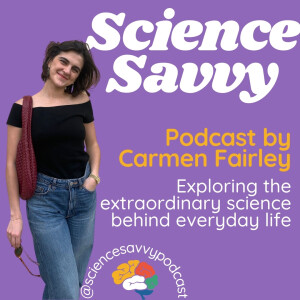
Science Savvy is a science and health podcast hosted by Carmen Fairley, drawing on a background in Pharmacology and Biomedical Engineering to explore the science behind everyday life.
Each episode turns complex research into clear, engaging stories, covering the human body, the brain, medicine, sleep, memory, pain, and scientific discovery.
Topics include women's health and hormones (PMS vs PMDD), the neuroscience of pain and how painkillers work, the science of sleep and dreams, near-death experiences and what happens when we die, and the biology of attraction, with expert interviews featuring doctors, researchers, and health founders.
Science Savvy is educational only and does not provide medical advice. Please speak with a qualified healthcare professional for personal medical questions.
Follow now and never miss an episode.








Episodes
Nov 7, 2025
Nov 7, 2025
36 min
In this episode, I explore the research history and neuroscience of psychedelic compounds, including how they interact with brain receptors and why they are being studied in controlled clinical settings.
The episode discusses current research, study limitations, practical challenges, and why these compounds should only be used within approved clinical or research environments.
This episode is educational only and does not encourage use outside approved settings.
Reading list: Available on request.
Oct 17, 2025
Oct 17, 2025
28 min
In this episode of Science Savvy, I explore how memory works and why it matters for learning, decision-making, and daily life.
The episode covers how memories are formed, stored, and retrieved, which brain regions are involved, and practical ways to improve recall.
Reading list: Available on request.
Sep 26, 2025
Sep 26, 2025
40 min
In this episode of Science Savvy, I speak with Elena Muyo, Scientific Projects & Partnerships Lead at CRIS Cancer UK, about how research funding can help advance new cancer treatments.
We discuss how projects are selected, why early research matters, and how scientific discovery can create new options for patients over time.
Reading list: Available on request.
Sep 4, 2025
Sep 4, 2025
29 min
In this episode, I speak with Aitana Padilla about genetics, the brain, and schizophrenia research.
We explore how DNA can influence biological pathways, how researchers study complex conditions, and why genetics is only one part of a much bigger scientific picture.
Reading list: Available on request.
Jun 3, 2025
Jun 3, 2025
35 min
In this episode of Science Savvy, I explore the science of happiness: what it is, why it exists, and how the brain helps create feelings of joy, satisfaction, and connection.
Drawing on my background in pharmacology and biomedical engineering, I look beyond the simple idea that happiness is “just dopamine” and unpack the wider biology behind positive emotions. This episode explores reward pathways, gratitude, social connection, meditation, brain waves, and why humans are not built to feel happy all the time.
From everyday habits to long-term wellbeing, this episode offers a clear and engaging look at what research can teach us about feeling good, staying grounded, and understanding our emotional lives a little better.
Science Savvy helps make science feel clear, useful, and relevant to everyday life.
May 15, 2025
May 15, 2025
38 min
In this episode, I am joined by Dr. Katharine D'Amico, a behavioral neuroscientist and President of the The Swala Institute for Applied Neuroscience for professional communication. We explore how your brain rapidly forms perceptions, builds (or breaks) trust, and makes high-stakes decisions.
My name is Carmen, I am the host of Science Savvy. I have a background in pharmacology and biomedical engineering. Science Savvy podcast is all about breaking down the extraordinary science behind everyday life.
In this episode, Dr. D'Amico shares her insights from mentoring over 900 startups and researching how trust and emotion shape behavior in professional environments. This episode covers why first impressions are sticky, how oxytocin builds trust and lowers stress, what role emotions really play in strategic decisions, and how to rewire your habits to make better choices. Whether you're curious about brain chemistry, leadership, mental health, or simply how to make smarter decisions, this episode offers clear and engaging insights grounded in real research.
Also, the cover at the beginning of the episode is from my band! Comment if you recognise it ;)
Further reading and references available upon request
Apr 22, 2025
Apr 22, 2025
34 min
Welcome to the Architecture and the Brain episode, part of Science Savvy with Carmen. In this episode, I explore how the built environment influences the way we think, feel, and connect with others. With my background in pharmacology and biomedical engineering, I break down the science behind sensory perception and neuroarchitecture, and unpack how it shows up in your daily life.
This episode covers the psychology of shared spaces, the impact of natural light and materials on mood and cognition, and why we’re hardwired to respond to beauty. I’m joined by Antonio, a talented architect, as we explore how thoughtful design can support mental health, foster community, and reflect evolving cultural values. Whether you’re passionate about urban planning, curious about how light and scent influence your brain, or just want to create a more inspiring space, this episode offers clear and engaging insights grounded in real research.
Science Savvy helps you understand the systems shaping your thoughts, health, and behavior. If you're ready to explore your body and brain with a little more clarity, you're in the right place.
Further reading and references available upon request
Apr 1, 2025
Apr 1, 2025
42 min
In this episode of Science Savvy, I explore the science behind Polycystic Ovary Syndrome, often shortened to PCOS. Drawing on my background in pharmacology and biomedical engineering, I break down how hormones, metabolism, insulin, and lifestyle factors can interact in this complex condition.
I’m joined by Dr. Basma Faris, a board-certified OB/GYN and certified culinary medicine specialist, to discuss why PCOS is about much more than ovarian cysts. We explore how insulin resistance can contribute to hormone changes, how sleep, nutrition, and stress can affect symptoms, and why clear, evidence-based information matters when navigating health advice online.
Whether you have experience with PCOS or are simply curious about how hormones and metabolism connect, this episode offers a clear, thoughtful look at the science behind the condition.
Science Savvy helps make science feel clear, useful, and relevant to everyday life.
Mar 11, 2025
Mar 11, 2025
26 min
In this episode of Science Savvy, I explore the fascinating science behind how food interacts with the brain and body. Drawing on my background in pharmacology and biomedical engineering, I break down how taste, smell, texture, nutrients, and the gut-brain connection can influence how we think, feel, and experience everyday life.
Joined by Pablo and Alicia, a food-loving couple, we discuss why food can feel rewarding, how it links to memory and mood, and why eating is often tied to comfort, connection, and shared experiences. From omega-3s and brain function to the science of cravings and the role of the gut, this episode turns complex research into clear, relatable insights.
Whether you are curious about nutrition, brain science, or simply why food plays such a big role in how we feel, this episode offers an engaging look at the science behind what we eat.
Science Savvy helps make science feel clear, useful, and relevant to everyday life.
Feb 18, 2025
Feb 18, 2025
42 min
Welcome to the Migraine episode, part of Science Savvy with Carmen. In this episode, I explore the science, stigma, and impact of migraine through the lens of lived experience and neuroscience. With my background in pharmacology and biomedical engineering, I break down the biology behind migraine and unpack how it shows up in your daily life.
This episode features a conversation with Dehenna Davison, former Member of Parliament for Bishop Auckland, who made headlines when she stepped down from her dream job due to chronic migraine. Dehenna shares her journey from suffering in silence to securing the first UK parliamentary debate on migraine since the 1960s. As someone who also lives with migraine, this episode is personal and deeply meaningful. Whether you experience migraine yourself or care about someone who does, this conversation offers scientific insights and emotional validation in equal measure.
Science Savvy helps you understand the systems shaping your thoughts, health, and behavior. If you're ready to explore your body and brain with a little more clarity, you're in the right place.
Further reading and references:
Goadsby, P. J., Holland, P. R., Martins-Oliveira, M., Hoffmann, J., Schankin, C., & Akerman, S. (2017). Pathophysiology of migraine: A disorder of sensory processing. Physiological Reviews, 97(2), 553–622. https://doi.org/10.1152/physrev.00034.2015Burstein, R., Noseda, R., & Borsook, D. (2015). Migraine: Multiple processes, complex pathophysiology. The Journal of Neuroscience, 35(17), 6619–6629. https://doi.org/10.1523/JNEUROSCI.0373-15.2015Charles, A. (2018). The pathophysiology of migraine: Implications for clinical management. The Lancet Neurology, 17(2), 174–182. https://doi.org/10.1016/S1474-4422(17)30435-0World Health Organization. (2022). Headache disorders: Key facts. Retrieved from https://www.who.int/news-room/fact-sheets/detail/headache-disordersSteiner, T. J., Stovner, L. J., Jensen, R., Uluduz, D., & Katsarava, Z. (2020). Migraine remains second among the world's causes of disability, and first among young women: Findings from GBD2019. The Journal of Headache and Pain, 21(1), 137. https://doi.org/10.1186/s10194-020-01208-0Buse, D. C., Manack, A. N., Fanning, K. M., Serrano, D., Reed, M. L., & Lipton, R. B. (2012). Chronic migraine prevalence, disability, and sociodemographic factors: Results from the American Migraine Prevalence and Prevention Study. Headache, 52(10), 1456–1470. https://doi.org/10.1111/j.1526-4610.2012.02223.xLipton, R. B., Bigal, M. E., Diamond, M., Freitag, F., Reed, M. L., & Stewart, W. F. (2007). Migraine prevalence, disease burden, and the need for preventive therapy. Neurology, 68(5), 343–349. https://doi.org/10.1212/01.wnl.0000252808.97649.21Prince, P. B., Rapoport, A. M., Sheftell, F. D., Tepper, S. J., & Bigal, M. E. (2004). The effect of weather on headache. Headache, 44(6), 596–602. https://doi.org/10.1111/j.1526-4610.2004.446011.xFinocchi, C., & Sivori, G. (2012). Food as trigger and aggravating factor of migraine. Neurological Sciences, 33(S1), 77–80. https://doi.org/10.1007/s10072-012-1046-5Diener, H. C., Holle, D., Solbach, K., & Gaul, C. (2021). Medication-overuse headache: Risk factors, pathophysiology, and management. Nature Reviews Neurology, 17(2), 112–124. https://doi.org/10.1038/s41582-020-00428-0Dodick, D. W. (2018). A phase-by-phase review of migraine pathophysiology. Headache, 58(S1), 4–16. https://doi.org/10.1111/head.13300Silberstein, S. D., Holland, S., Freitag, F., Dodick, D. W., Argoff, C., & Ashman, E. (2012). Evidence-based guideline update: Pharmacologic treatment for episodic migraine prevention in adults. Neurology, 78(17), 1337–1345. https://doi.org/10.1212/WNL.0b013e3182535d0cTepper, S. J., & Ashina, M. (2019). CGRP and migraine: The emerging role of CGRP inhibitors. Headache, 59(3), 394–406. https://doi.org/10.1111/head.13456Russo, A. F. (2015). Calcitonin gene-related peptide (CGRP): A new target for migraine. Annual Review of Pharmacology and Toxicology, 55, 533–552. https://doi.org/10.1146/annurev-pharmtox-010814-124701Lipton, R. B., Munjal, S., Alam, A., Buse, D. C., Fanning, K. M., Reed, M. L., & Schwedt, T. J. (2022). The impact of migraine on workplace productivity and the role of novel treatments. Headache, 62(3), 334–345. https://doi.org/10.1111/head.14286

Carmen
Hi, I’m Carmen, and I’m so excited to have you here.
Science Savvy is my podcast about the human body, the brain, medicine, and scientific discovery. After studying pharmacology and biomedical engineering, I wanted to create a space where curious people could enjoy learning about science in a clear and engaging way.
Thank you for being part of the journey.